Pages

Tuesday, 9 January 2018

The collector of stories


I am a collector of stories.  We are all collectors of stories - not only the fiction that comes in books but our own stories, our families', the stories of people we don't even know.  Family legend, anecdote, gossip, speculation, news, jokes, dreams, ambitions ... they are all stories and we love them.  Stories help us make sense of the world, help us make new worlds.  We love to hear them, read them, tell them and share them.

I have sometimes thought of being a professional eulogiser - if that is even a thing - not because I have a morbid need to find myself regularly at funerals, but because I have always believed that people's stories matter.  They should never be neglected.  I am saddened if, at the last moment, even the seemingly unassuming person in life does not enjoy the respect of having their story told in death.  Because everyone has a great story.  If you can get beneath the surface, peel back the layers of 'ordinariness', there is always a surprise. 

Stories have found me in unusual ways recently, delivered via  - a vintage gold embroidered chocolate box full of letters scrawled on psychedelic notepaper; a navy blue 1941 pocket diary with hasty commentary on the Blitz in London; and the 19th century gravestone of my great great grandparents 'washed up' improbably in Tasmania, thousands of miles from its resting place.

From them I hear a teenage girl at Boarding school in the 1970s pleading with her sister to post the one thing she wants above all else right now - her 'Tap Turns on the Water' record.  I hear the discomfort of a man sleeping under his kitchen table during an air raid and dreaming up ways of shaking off Irene who is determined he is the only chap for her.  I hear of the death of Matilda, my great great grandmother, from exhaustion after three years with tuberculosis.  She is thirty nine and one year earlier gave birth to Louisa, my great grandmother.  How differently my own story could have twisted.

I love them all, not only the one upon which my own story depends, I love stories.

Monday, 1 January 2018

New beginnings


The truth is, of course, that every moment is a new beginning - the beginning of what comes next - and in every moment is the potential for a fresh start.  To embrace this is truly exciting, empowering.  At any moment I can choose a different course.  It doesn't matter that I haven't exercised that choice until now ...  Now, I can.  Or now. 

No new beginning is more seductive than the New Year.  It bursts into life with ever more fireworks and in their colour and energy are painted every kind of dream.  Mine are remarkably consistent each year and if I haven't found the way to make them come true quite yet, it is perhaps because I haven't taken my courage firmly in my hands and opened my heart to let them in.  The trouble with dreams that you don't take hold of is that they can become the pot of gold at the end of a rainbow.

I have been unravelling the story of my great great aunt Annie.  Born in 1854 in an English market town, her mother died of TB when she was ten, and her father, a baker, of a stroke when she was seventeen.  Two years later she had taken her courage in her hands and was making a new life for herself on the other side of the world in Australia.  Whilst this kind of long haul travel is almost a rite of passage for gap year teenagers now, it wasn't then.  A glance at the generation that accompanies her on my family tree shows she was a pioneer.  I am struck by her courage.  There were other options to survive but she chose to be brave and dared to make her own dream.  She also followed her heart; this is a love story too.

New beginnings, at the New Year or any other time, usually contain those two ingredients: courage and love.

Happy New Year.

Tuesday, 19 April 2016

Opening the heart


When the heart 
Is cut or cracked or broken,
Do not clutch it;
Let the wound lie open.
Let the wind 
From the good old sea blow in
To bathe the wound with salt,
And let it sting.
Let a stray dog lick it,
Let a bird lean in the hole and sing
a simple song like a tiny bell,
And let it ring.

Michael Leunig

I have let the 'good old sea blow in' to my heart over the past few days.  It's been extraordinarily cathartic and creative.  But it's true.  It does sting.  

Thank you Michael Leunig for your beautiful writing and thank you all the people who shared the poem along the social media path to find me.  It arrived on the third anniversary of my sister's death.   
I am a passionate believer in the power that is unleashed by opening your heart, - wounded or not - and letting it be true and vulnerable.  That is when I am at my honest and creative best.  That is when magic happens in my life because I stop getting in the way of myself.  It's when I'm happiest and most alive.  And if there isn't a sea wind available, then a brisk one will at least blow out the cobwebs.  Oddly, it's one of the hardest things to do, especially perhaps if you've been brought up with a stiff upper lip!  My yoga practice is powerful therapy against this apparently British trait.  It encourages me to open heart and spirit to life in an extraordinary way.     

How does opening your heart inspire creativity?  I don't have a scientific, foolproof answer for that question.  I believe simply that if I am in touch with myself, I am also much more intuitively in touch with the world 'out there', with other people, and with characters in books and stories, those created by others and those I am creating in my own writing.  We spend a lot of life thinking rather than feeling and creativity is sparked from feeling; that requires some letting go and, sometimes, a willingness to let in the salty wind.

Anniversaries gnaw at wounds, there is no denying it.  My desire was to embrace the emotions and channel them into an affirmation of life.  This is the path I feel is right for me.  It may not be for everyone.  Yet I so nearly kept my upper lip stiff and ignored the unique quality of the day.  Michael Leunig's poem was an inspiration to throw open how I was feeling, not to wallow but to embrace.  It is, after all, a privilege to be who you are each and every day and to create as much beauty and happiness as you can with what you've got.

By connecting with how I truly felt, a lot of things shifted for me creatively and personally, and in a rather effortless way.  A story for children came to me in its entirety and I sketched out the bones feverishly from start to finish so that it wouldn't fade like a rainbow.  I finally saw a way through the stalemate on another piece of work which I know has legs but which has been sitting waiting to run for a while.  I saw exactly the kind of poet I am aspiring to be although I declared a week or so ago that I wasn't looking for a role model!  I began to see how two of my big dreams might be possible if I simply open to their possibility ...

I let the bird lean in the hole and sing.


After reading Michael Leunig's poem, I shared my thoughts about the anniversary of losing my sister on social media.  I'd had no intention of doing so .  The loving kindness I received back was humbling and overwhelming.     


Tuesday, 12 April 2016

A Shakespearean Spring


When proud-pied April, dressed in all his trim
Has put a spirit of youth in every thing.
Shakespeare, Sonnet 98 2-3

From my desk I have a view of the garden and when I look up I can see the toings and froings of birds to two different nests.  If I crane my neck, I can see the steady construction and furnishing with feathers and moss of two more.  The 'spirit of youth' - energy, hope and forward-looking - is in every thing.  It's infectious.  

As well as writing and sowing vegetable seeds, one of my April projects is to learn more about Shakespeare and his world.  I'll be beginning a ten week online course offered completely free of charge through FutureLearn.  The lead educator on the course is Professor Jonathan Bate, a Shakespearean expert.  The course coincides with the 400th anniversary of Shakespeare's death on 23rd April which seems a fitting time for the first full dipping of my toe into the Shakespearean pond since A levels.  It's an exciting prospect!  The course starts on 18th April and is open to all, no previous experience or qualifications required.  Simply sign up here.    

April is the month of sunshine and showers: this April is a golden example.  I love the way Shakespeare captures the wonderful duality of the month and the uniqueness with which it seems to stand between seasons 'proud pied April'.  When you're a 'pro', a few words suffice!  It also reminded me of another poem I found recently which revels in the 'pied' nature of things, Pied Beauty by Gerard Manley Hopkins.

Glory be to God for dappled things - 

it begins.  I'm not sure whether it's exactly what he had in mind but it conjured for me the French expression, 'Vive la Différence' , an invitation, an exhortation even, to celebrate what makes each of us, and everything, different, special, dare I say 'eccentric' if we chose to embrace it.  Perhaps he was thinking along these lines. Later in the poem he writes:

'All things counter, original, spare, strange; ...' 

but for me both of them remind me of the yin and yang of nature; the notion that all things contain something of their opposite within them.  You cannot have one without the other.  

I'm going to be writing my own April poem this week, featuring the first swallow of the year.  First though, and rather against my will, I am writing a dementia related poem.  It will be about losing the line of communication and it seems to be forcing my hand to be written.  Dementia is something I don't write about usually because reflecting on it brings pain into the creative mix. Yet here is where I do have an authentic voice.  So this will be the pied nature of my work this week.  I am also taking my first baby steps towards thinking about a longer piece of work.  April is certainly a brisk, no-nonsense kind of month!

Next week I hope to share some thoughts on how yoga is helping me write.  It may seem a bit of a stretch (pun intended) but I do feel the patient, regular and structured practice is opening creative doors.  

Whatever your creative projects are this week, I wish you well.

Kelly x            


All of the wonderful photos on this blog are by Andrew Holman

Tuesday, 5 April 2016

Ladybirds, Mother Goose and the wisdom of children.

Can we learn wisdom watching insects now,
or just the art of quiet observation?
Creatures from the world of leaf and flower
marking weather's variation.

From Summer of the Ladybirds by Vivian Smith


Inspired by the fascination of three year old twins, I am writing a poem about ladybirds ... and life.

Poetry is a genre re-discovered for me and I am diving into it with the bliss of the uninitiated. I have no concern for rules or meter, for rhymes or a formal dance of A,B and C.  I am simply riding a wave of naivety, writing about the things I observe and think in what seems like a poem kind of way.  It's glorious and rather childlike and, based on the very intense interaction the twins had with the ladybirds we found on a patch of stinging nettles, probably the perfect springboard into poetry.

There are excellent books about writing poetry, top of my list is Stephen Fry's The Ode Less Travelled.  I know I will enjoy it because I listened, riveted, to a long discussion about poetic form he had with Professor Jonathan Bate.  Who knew a subject apparently as dry as a stick could be, frankly, so juicy!  In time his book will, I know, open a door for me into a magic land of metre, rhyme and verse.  And I am looking forward to that day immensely.  But for me this year of writing, (which I started on my birthday) is about finding confidence in my own voice as a writer, coming back to how it sounds, its nuances, its own rhythm, the things that make it laugh and the circumstances when it adopts a minor key.  This sounds so obvious - to have one's own voice as a writer, or indeed in life - and yet how easy it is to be tossed and turned by the influence of others and to lose what it is you have to say. My plan is to collect together the year's poems and put them 'out there' in some form.

Although I am very deliberately not reading about writing poetry, I am reading poetry.  It's an eclectic, or perhaps more accurately, a random selection!  I'm dipping into things and not sticking with one writer for more than a poem or two.  I'm reading poetry for the pleasure of it and not looking for rules or influence.  The Poetry Foundation website is a great online resource for this kind of poetry pond dipping.  Today, searching on 'ladybird', I was offered two poems.  The first, Vivian Smith's poem, quoted above, draws reflectively on the intimate relationship we have with this tiny, magical insect.  And then who could forget;

Ladybird, Ladybird,
Fly away home,
Your house is on fire,
and your children all gone:
All except one
And that's little Ann,
And she has crept
Under the warming pan.

attributed to Mother Goose and perhaps one of the most beloved poems ever.   


All of the wonderful photos on this blog are by Andrew Holman

Tuesday, 29 March 2016

Sit here. Read.

The Time will come
when, with elation
you will greet yourself arriving
at your own door, in your own mirror
and each will smile at the other's welcome,

and say sit here. Eat. 
You will love again the stranger who was your self... 

from 'Love after Love'.  Derek Walcott

I learned something about myself recently: something I've known all along, from childhood, yet allowed myself to set aside in the 'maturity' of adulthood.  Reading is lifeblood.  How could I have forgotten?  

I have never stopped reading, never lost the excitement of seeing a stack of books waiting to reveal their secret worlds, but I had let myself define it as an indulgence, something to earn, something to feel ever so slightly guilty about...

When I read Derek Walcott's poem, Love after Love, I smiled.  The journey of life often feels like coming back to yourself.  To me, right now, the first line of the second stanza reads:
'and say sit here.  Read'.

Sheer pleasure.  This is the reason to read.  It makes me happy.  No other justification required.  Yet reading is beyond entertainment.  To delve into literature is not mere distraction, it's a journey into what it means to be human.  It's also beyond intellectual, it's visceral.  I remember myself, a twenty one year old French student, basking in the sunshine on the Plage de la Chambre d'Amour near Biarritz, Le Rouge et Le Noir in hand and feeling 'this is me' and yes, the beach was beautiful and love was in the air, but it was all about the reading.

Recently, in a fabulous short course Literature for Mental Health: Reading for Wellbeing, I have been exploring some of the great things literature does for people.  The course has turned me into an aspiring bibliotherapist.  My favourite fictional bibliotherapist is Monsieur Perdu who lives in Nina Simone's wonderful book 'The Little Paris Bookshop'.  Monsieur Perdu is a 'Literary Apothecary'. He prescribes novels for 'the hardships of life.'

For me 'bibliotherapy' is a relatively new term.  I hope my personal practice of it will involve the sharing of magic and the exploration of that visceral need to read with all the amazing benefits it brings.  I am working on my first 'bibliotherapy' project right now, inspired by the course, and am super excited about it. I'll tell you more as it unfolds.  

The Reading for Wellbeing course is divided into six topics: stress, depression and bi-polar, heartache, grief, PTSD, and dementia.  Reading lovingly selected texts, many of them poems, and sharing heartfelt reflections with course contributors and fellow learners set me alight. And I came right back to that thing I knew all along: reading is lifeblood.  At all times of life poems, novels and plays, full of the stories of humanness, can be the friends that lead us to the heart of ourselves.


Tuesday, 22 March 2016

Turning dragons into peacocks

When I was on the road to recovery from a depression over a decade ago, a friend sent me some spirited words of encouragement:

"And sometimes when our fights begin, 
I think I'll let the dragons win ...
And then I think perhaps I won't,
because they're Dragons and I don't"

He repeated them every year in Christmas cards as a kind of rallying call to face down any lurking demons.

Only recently did I wonder about their provenance.  They are from 'Knight in Armour', a poem in the children's collection 'Now We are Six' by A.A. Milne.  You can read it or listen to it here. 

The poem suggests two approaches to dragons: fight them or let them triumph.  It's classic win or lose, fight or flight territory, and faced with a green fire-breathing monster the latter  - run away as fast as possible - definitely sounds like a good option.  But how about metaphorical dragons?  At a storytelling yoga workshop recently, led by Claire Murphy, I was presented with a third option for dragons, demons or beasts of this persuasion: transform them into a peacock.

Claire told the story of Skanda, son of the Hindu God, Shiva, who volunteered to 'deal' with a many-eyed monster after countless others had run away or failed to slay it.  Skanda took a different approach.  He captured the beast, a behemoth really, and, being a deity, transformed it into a peacock, every eye the brilliant centrepiece of each of the bird's iridescent feathers.  Then he rode around the heavens on the peacock's back.

I love the story, love the invitation it offers to see things in less black and white terms and be more creative with challenges.  Instead of slamming into them like an American footballer or trying to escape them, can I work with them creatively?  This is a softer, more compassionate approach and work I've been doing recently with Mindfulness is helping me to see that metaphorical dragons might respond in interesting ways when offered this kind of treatment.  I've decided to try more of the 'peacock' approach to get around the obstacles I think hold me back.  Many of mine, as you might have guessed, are around writing but 'dragons to peacocks' could work for any field.  So I'll be stroking, tickling and pampering my dragons - giving them the chance to show their soft belly - to see how this works for me.  When it comes to the real, fire breathing variety though, I'm still with A.A. Milne: bring me my sword, helmet and breastplate!

Postscript.  After I had finished writing this post, we found a tiny peacock feather underneath the sofa.  I'm sure we collected it once upon a time but my husband - he promises - has vacuumed there regularly and never found it.  I like to think Skanda dropped the feather in a moment of divine playfulness, but I really don't know how it got there. 


All of the wonderful photos on this blog are by Andrew Holman

Tuesday, 15 March 2016

A birthday gift - one wild and precious life


Tell me, what is it you plan to do,
with your one wild and precious life?
Mary Oliver

It's my birthday today.  Happy Birthday to me!

I am 51 years old - something I never thought I would admit in public yet something which, increasingly, I consider immaterial (work out that contradiction if you will), except that I could not be the person I am, writing here this morning, without the half century of personal experience that has gone before.

In my mid thirties I suffered a depression;  my second confession in as many paragraphs - I have dear friends who have no idea.  It threw me, painfully, out of the tidy, successful and conventionally prosperous groove I had expected to travel along.  It stole confidence and instilled shame.  Then a lot of 'stuff 'happened, and I use that word not to diminish its significance but because the 'stuff' was sad and difficult and now is not the time.

As my fifties loomed closer I began to look around me and see that the world was full of people who were not living the lives they had hoped or doing things that made them happy.  I was, of course, using them as a mirror for myself.  Had I, I wondered, left it too late to be me?

I come full circle: without the half century of personal experience that has gone before, I would not be me.  And, having understood that 'is it too late?' is never the right question, my fifties are turning into a real renaissance. I am beginning to embrace opportunities (which pop up when you open your heart), and starting projects about which I feel passionate and, most importantly, which make me happy.  My life is getting wilder!

Every birthday is a renaissance and I love to use Mary Oliver's words to remind me of this:

Tell me, what is it you plan to do, with your one wild and precious life?

They have become something of a mantra.  While the temptation might be to use them as an exhortation to pick experiences from a bucket list, in the poem from which they come Mary Oliver has been lying in the grass watching a grasshopper.  It is this simple and personal experience of a summer day which leads her to ask us the question.  

"I do know how to pay attention, how to fall down
into the grass, how to kneel down in the grass,
how to be idle and blessed, how to stroll through the fields"  

"Tell me, what else should I have done?
Doesn't everything die at last, and too soon?
Tell me, what is it you plan to do,
with your one wild and precious life?"


I have been asking myself why I am sharing all of this (the delete key is calling, believe me).  I think it's because I know how it feels when the wildness goes out of life and you are left wondering how to get it back. You can try too hard to find it and look in all the wrong places.  In the end, it seems to me, you have to come back to your very own wild and precious life, no one else's will do.  For me things started to change when, finally, I began to let myself do the things that make me feel idle and blessed and I began to open up my heart to what came along.         

Happy Birthday to me and my newly wild and precious life.   


Read the whole poem 'The Summer Day', aka The Grasshopper here

Listen to Mary Oliver read her poem 'The Summer Day' here


All of the wonderful photos on this blog are by Andrew Holman

Tuesday, 8 March 2016

Using my voice on International Women's Day


Lichfield Cathedral had turned its back to the lashing rain.  Gulls were careening along the river as if they would catch the raindrops before they merged into the flow.  Funny how moments become encapsulated in the mind.

Perhaps it was because my breath had clouded the window or perhaps it was the steam climbing from my bowl of mussels, but when my father-in-law asked why I had stopped blogging, I replied that I feared what I had to say was simply a lot of hot air. The world is already too full of it, I said, as if sending my words out into the ether were accelerating climate change.  This is, I believe, a common fear amongst writers;  their words being only so much hot air, that is.  Climate change is a pressure too far!

I've had a change of heart.  I have a voice, and I have decided to use it.  It was Tony Benn who said that the greatest gift you can give is encouragement.  I'm very grateful to my encouragers, chief amongst them my husband and father-in-law, who have convinced me to get back in this seat!

International Women's Day is a fortuitous and fitting day to exercise my voice as a woman.  There are people all around the world today, men and women, who are suppressed and unable to use theirs but it is a fate still more commonly that of women.  When I look back only a generation into parts of my own family, I see plenty of women whose voices were not heard, who, through lack of education and confidence, hardly dared to raise them.  This is not my fate.

More personally and poignantly, both my mother and my sister were robbed of their voices through illness: my sister as a result of a subarachnoid haemorrhage, my mother as a result of her ongoing dementia.

Using my voice has come to symbolise something important for me.  

The question now is: what will I tell you?  That's what I'm looking forward to finding out.

I plan to be here most often on Tuesdays.


All of the wonderful photos on this blog were taken by Andrew Holman

Friday, 4 December 2015

Lovely Uttanasana

One morning this week I left the yoga studio feeling inordinately proud of myself.  My yoga teacher had complimented me on a lovely Uttanasana.  Going back millennia people have walked along Stony Stratford High Street, part of an old Roman road, feeling proud of many things but possibly not their Uttanasana!

Uttanasana is the Sanskrit name for a standing forward bend in yoga and if you Google it, you'll immediately get a picture of how it looks.  That morning mine was lovely and I was 'chuffed'.  Then I stopped myself.  What was all this ego stuff about being able to do a forward bend?  My pride became tinged with a touch of guilt.  Yoga is not an ego trip, and I wasn't going to make the world a better place with my forward bend.  Perhaps I wouldn't mention it to anyone after all.

Then I thought about how great it is to celebrate good moments, things, however small, that make you happy.  I have been working on my Uttanasana for almost a year, slowly, carefully, bending and becoming more flexible.  And in all that practice, it hasn't been about aiming for perfection or trying to be better than anyone else.  It's been about the moment itself and about the journey of transformation.  It's been a joy to feel increasing flexibility in body and sense this extending to mind: to feel myself stretching towards a lovely Uttanasana.  So, yippee!!

I love all forward bends, standing and seated.  They are favourite elements of a yoga practice for me. Whilst we are so often pushing ourselves towards the next boundary in everything, it is also wonderful to relish those things we really enjoy.

If I love forward bends, I am ambivalent about backward bends (anuvittasana).  I find them more difficult and it's a lot to do with liking to see where I am going, or, not liking to go where I can't see. So the journey continues, but it's always good to enjoy its steps.


All of the wonderful photos on this blog are by Andrew Holman

Tuesday, 1 December 2015

The 'dire' expectation - a step towards liberated writing


This week I am feeling liberated as a writer.  The breakthrough moment came after reading some advice from a writer I have discovered recently, Safia Moore.  She won the Bath Short Story Award and blogs at Top of the Tent.

Hers is a confident voice when it comes to discussing the craft of writing, and I find her thoughts inspiring.  The piece of advice that turned my writing desk upside down was in an interview she gave to The Short Story.   Talking of writing in general, she said:

'Expect the first draft to be pretty dire'.

Perhaps you are raising your eyebrows quizzically at this point.  Or maybe you can identify, like me, with the comfort those words offer.  It can be utterly dispiriting to come back to the first draft of a story, or to yesterday's writing, for which you had such high hopes, only to discover that it is nowhere near as delicious as you had imagined. If you're not careful, your inner critic finds its voice and you let it convince you that you are not, and never will be, a real writer.  That may sound melodramatic, but it happens.  Of course you know that all writers edit their work and go through many drafts, but it is only too easy to believe that your first draft takes all the prizes for lousiness. Other writers, you think, edit to make already good writing, superlative.  You, on the other hand, edit to spare yourself humiliation.

Expecting the first draft to be dire, far from being pessimistic, is a relief and it's freeing me to write. Now my first aim is to get my story onto the page whole, however roughly.  That's the job of the first draft: to capture the story and not let it slip away.  I know it's going to be rough and I embrace this roughness.  This enables me to keep on going with a piece and stops me from looking back and trying to meddle with the raw story as it emerges.  All too often, (very very, very often) I have not completed a piece at all because I've got stuck in that kind of meddling.

The good news is, I think, that after the story has been 'captured' in first draft, you have the time to play with it.  You've got this messy draft in front of you and you can start to cut and polish it and make it sparkle.

It's early days but the acceptance that my first words will be far from brilliant feels like a paradigm shift in writing for me, a way of getting around myself and on with the job.


All of the wonderful photos on this blog are by Andrew Holman

Friday, 27 November 2015

Books and the Black Dog on Black Friday


 'The only end of writing is to enable the reader better to enjoy life or better to endure it.'  Dr Samuel Johnson  
Reading has always fulfilled these aims for me.  The sheer enjoyment of other people's writing makes me glow.  There is the pleasure of escapism: when I'm deep in a novel, I think of little else. It's also the best spur to my own creativity.

I listen to children reading at a Primary School every week.  The power of the subjects their literature explores never ceases to amaze.  Through it they seem to feel safe to imagine and confront some very challenging situations.

So I jumped at this course Literature and Mental Health: Reading for Wellbeing which takes Dr Johnson's premise as its starting point.  It's free, online and offered by the University of Warwick via Future Learn. The start date is 1st February 2016.  Most of my friends from our school A level English Literature group have signed up too.  We haven't discussed literature together since ... the last century!!  I'm so excited by this opportunity.

The themes over six weeks are:
Stress
Heartbreak
Bereavement
Trauma
Depression and bipolar
Ageing and Dementia

all explored through the work of a range of writers.    

The reading material is provided online but the course organisers suggest that, if you are raring to go, you could take a look at one or two of the following:

Jane Austen: Sense and Sensibility
Rachel Kelly: Black Rainbow
Melvyn Bragg:  Grace and Mary
Mark Haddon: Polar Bears
William Shakespeare: King Lear, Hamlet, Titus Andronicus
An anthology of poetry of your choice.

What an invitation!


All of the wonderful photos on this blog are taken by Andrew Holman


Friday, 20 November 2015

The magical power of the breath in the night

It's 3 am.  No one is up except you and the stars.  You woke because the neighbour's cat was caterwauling outside or you needed the loo.  You squeeze your eyes tightly shut and tell yourself firmly that you are going STRAIGHT BACK TO SLEEP ...

And then they descend like rowdy friends after a drunken party; those thoughts that won't give you any peace.  You try to ignore them but they are so damned loud!  Before you know it, you are listening to every word they say and none of it is soothing.

In fact, these unwelcome visitors are downright aggressive, questioning you and pointing out all of the things you haven't done or should have done better.  'Why haven't you done your Christmas shopping yet?'  'Why on earth did you say that today in the office?'

They're relentless.  They start to question your capabilities too. 'Do you think you'll be able to manage that project tomorrow?'  'Are you sure you haven't bitten off more than you can chew in your new career?' They even question your character.  'Are you a good friend/mother/daughter/wife? Then why didn't you ...?'

You try not to retaliate, but it's no good. They suck you into the debate and you answer back.  'I would have enough time and energy for that project tomorrow if I could only GET TO SLEEP!'

By now you're wide-eyed, your heart is racing and you're hot and bothered.  You can feel those stress hormones coursing through your body and you know you'll only drop back to sleep again five minutes before the alarm.  It's so frustrating because you understand you're the author of your own sleepless night and now everything that might have been challenging tomorrow is going to be doubly challenging. That vicious merry-go-round of thoughts keeps spinning round and you can't jump off!

My regular yoga practice means that I have far fewer sleepless nights, but they still visit me now and again.  One of the best ways I have found to stop them is a simple breathing method.  For me the effect is almost magical.

All you do is focus on your breath.  You don't count breaths, you don't try to change them.  You simply turn your attention to the exhalation.  Each time you breathe out, you let it be in 3 stages. You don't hold your breath at any point, you just let it out as if you're descending down three stairs in one flowing but stepped movement.  I keep it up for as long as I need to.

Hopefully you will find it as calming as I do and with a bit of luck you will drop to sleep, but I don't make that my aim, I just keep breathing in and gently out down those three steps.  Good luck!

I am indebted to Mona Baur, one of the lovely teachers at Whitespace Yoga, for teaching me this technique.  Her own inspiration is The Breathing Book by Donna Fahri.  It's on my Christmas list. 

Kelly x  


All photos © Andrew Holman.

Tuesday, 17 November 2015

The core of things

I love these dark weeks of November and December.  I have always found them to be a rich and meaningful time.  Everything is stripped back and the cold and dark encourage a journey inwards. Nature reflects this.  The golden leaves of autumn have dropped and the trees are laid bare, revealing their structures: what is at their core.

In my yoga classes, I have been working on my physical core where there is much strengthening to be done!  For me it's a real challenge.  To rise to it demands my focus and determination, in other words: a strong mental attitude.  Whereas I am happy to work on forward bending and flexibility all day long because I love it, core strengthening requires a different frame of mind.  However, my attitude is shifting.

What's fascinating is to see how the physical work is strengthening all parts of me.  It is an enlightening process.  I don't want to overdo the point, but I truly do find I am re-discovering the core of myself.

Over the past decade, I have felt out of touch with my core, tossed on the waves of fortune, not sure which course to try and steer.  I have tried to be many things, often for seemingly worthy but probably misguided reasons.   Re-tuning with myself turns out to be rather a relief.  I feel lighter with the strengthening sense of self just as I feel lighter physically as my core muscles grow stronger.  It's so hard to put into words and yet it feels very natural.  

I am reading 'Super Brain' by Deepak Chopra and Rudolph E. Tanzi.  It has got me super excited and I recommend it highly.  With all the 'core' work I'm doing, you can imagine how the following words from the book resonate with me:  
To have a core self is to be the author of your own story.
I feel that in these words lies a deep truth, one that fills me with optimism.


Friday, 6 November 2015

Picking more daisies

In one of my yoga classes last week, our teacher, Ali, read us a poem.  Reportedly written by an octogenarian woman called Nadine Stair who is reflecting on her life, the poem is called 'If I Had my Life to Live Over'.

You will find the poem sprinkled liberally over the Internet on blogs and websites devoted to happier modes of living.  I wondered whether it would be okay to reproduce it in full here.  I have decided that Nadine Stair wanted her reflections to be shared: so I will.

As it becomes colder and the days shorten, it feels like the perfect time to become a little more reflective myself; to sit by the fire and think about what comes next.  So I am working on my personal version of a poem like Nadine's.  To write it, I am simply thinking about the things that make me happy and fulfilled and the things that don't.  It's not a 'bucket list' poem of goals to achieve, destinations to visit etc.  It's about understanding what I would like the essence of my life to be.  I think I'm going to call it 'For the Rest of my Life'.  It's good fun: it's making me smile.


This is Nadine's poem about her life.  

If I had my life to live over,
I'd dare to make more mistakes next time.
I'd relax.  I would limber up.
I would be sillier than I have this trip.
I would take fewer things seriously.
I would take more chances.

I would climb more mountains and swim more rivers.
I would eat more ice cream and less beans.
I would, perhaps, have more actual troubles,
but I'd have fewer imaginary ones.

You see, I am one of those people who has lived sensibly and sanely,
hour after hour,
day after day.
Oh, I've had my moments, and if I had to do it over again,
I'd have more of them.
In fact, I'd try to have nothing else,
just moments, one after another,
instead of living so many years ahead of each day.

I've been one of those persons who never goes anywhere
without a thermometer, a hot water bottle,
a raincoat and a parachute.
If I could do it again, I would travel lighter than I have.

If I had my life to live over.
I would start barefoot earlier in the spring
and stay that way later in the fall.
I would go to more dances.
I would ride more merry-go-rounds.
I would pick more daisies.

Nadine Stair


Tuesday, 3 November 2015

A rainbow of Cuban cars

All the world loves Cuba's cars.  They have become the island's trademark and its major tourist attraction.  I was surprised to find myself falling in love with them too; I am no petrol head.  Today, I am sharing a rainbow of them and in putting them together, I can see exactly why I loved them: they are so bright, so vibrant, so shapely.  They put fun and colour into the everyday of life.    
Red: luscious lips, strawberries, Rudolf's red nose.
Orange: autumn leaves, fire, sienna

Yellow: sick as a parrot
Green: pistachios, lime, my sister's favourite colour


Blue: sky, sea, toes on warm sand

Indigo: passion and hope
Violet: Shrinking


Pink:  Sometimes a Dodge, sometimes even a Cadillac but not technically a colour of the rainbow!


All of the photos were taken by Andrew Holman


Photos © Andrew Holman.

Tuesday, 27 October 2015

Compassion, hope and encouragement: my choice of travel companions

This morning, over a cup of my favourite Assam tea, I sat and looked at the gorgeous autumn colours in the garden.  The sky was grey and there was drizzle in the air but the tree opposite my window glowed.  Its golden leaves lit everything like a beacon.  I began to imagine that it symbolised a person who was full of love and compassion.  When you meet someone like that, it's exactly what they do: glow and light up the space.

It has turned out to be a beautiful train of thought, because I have started to think of all the people I know who glow like this.  There are quite a few.  One I remember from my childhood.  Whenever she met my sister and me in the town where we grew up, she would bathe us in her glow of love and compassion.  She always had encouraging things to say, a cuddle and a gift; there was always a gift. What I remember though is her glow.  It came from within and bathed us all so that even now, decades later, I feel its warmth.  It is a touching memory.
Wouldn't it be wonderful to glow like that?  To feel deep love and compassion first for yourself and then for everything around you.  That's what she had, I'm sure of it, a loving compassion for herself which simply spread.  I know others who radiate the same.  I'm grateful for their presence in my life and for the memory of some of them this morning.

Compassion for myself, cutting myself some slack, has been my 'theme' this past week and I've been horrible to live with as I try to take my less than compassionate self on board!  The gorgeous autumn trees and the people they symbolise have reminded me it is simply about love.

I'm going to save hope and encouragement for a future post.  My yoga mat calls.


Kelly x


All photos © Andrew Holman.

Friday, 23 October 2015

The man with a name. Havana

We took pastries to the Parque Alejandro de Humboldt on our last day in Havana: cigarillos, the least sugary treat available from the cabinets of biscuits, cakes and pastries so sweet that even looking at them sent your glucose levels skywards. The queues for them stretched out of San José bakery into Calle Obispo every day. Sugar, along with tobacco and sunshine - all plentiful in Cuba - must surely be pillars of the Cuban Revolution.  
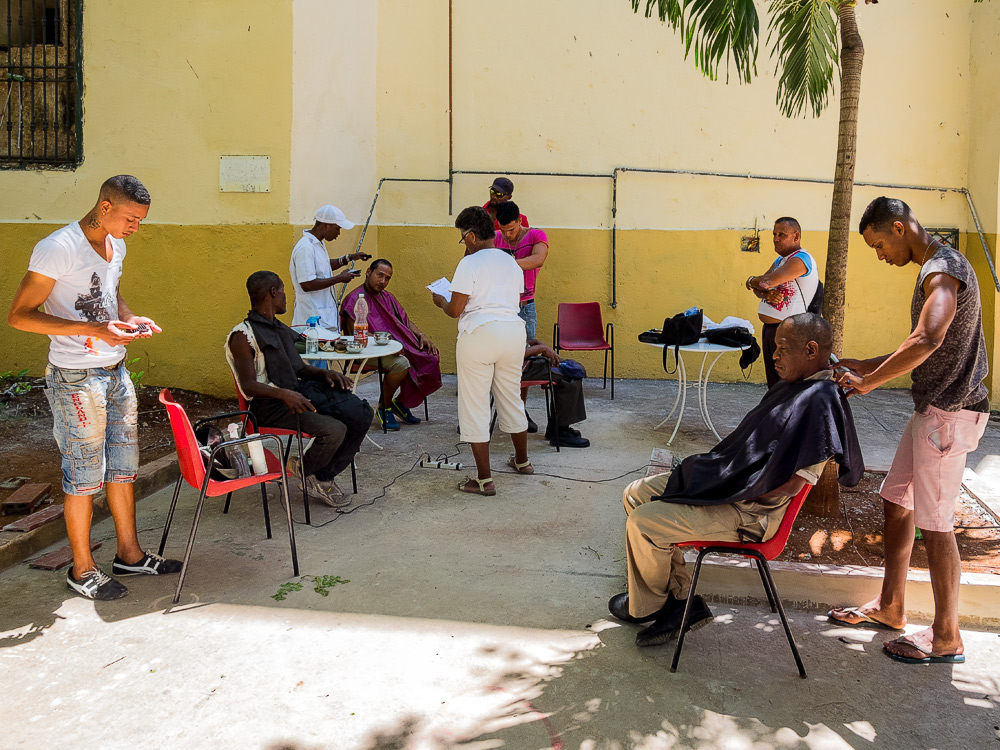
The square was busier than usual.  Some of the old ladies from the day care centre had stepped outside to enjoy a cigarette under the shade of the palm trees.  In the corner, an outdoor hairdressing salon had set up.  Trainees were getting in some practice, offering trims and re-styles to passers-by who could have a new look for free if they were willing to risk a scalping.  We found a bench and settled to watch.  
The park had become one of our favourite lunchtime spots, a cool oasis to rest after mornings spent walking the streets of Old Havana beneath an ever brighter sun.  Each day we shared the shady benches with familiar faces, mostly old gentlemen who seemed to have no place to go and who we came to think of as lunchtime buddies.  They, dotted around the small park, had no idea we thought of them as part of our lunchtime gang but were always pleased to see us.  

It had started with spare bananas.  We always had spare bananas, at first by accident, then deliberately.  Cuban bananas are tiny and delicate in flavour, it felt good to share and enjoy them together.     

Today one of the old gentlemen sat opposite.  A free haircut walked along the path between us: a young woman, red around the ears. Our friend raised his eyebrows skyward.  I smiled.  It seemed neither of us were sure about the Mohican she had chosen.  It broke the ice.  We offered him a cigarillo with the usual bananas and then munched in companionable silence as a man walked by with a parrot on his shoulder and a group practised walking up and down the rehabilitation ramp at the centre with their Zimmer frames.   
One of our lunchtime buddies
We had brought a bag of small gifts too, items difficult to find here that we did not need to take home.  Giving, even with the best intentions, can be tricky.  Our friend became uncomfortable.  He made us understand he was not a beggar, did not expect anything from us.  In what was, for me, one of the most poignant moments of our trip, he pulled out an identity card and showed it to me. The print was too small to read his name but I understand it wasn't about that.  He wanted to say he was someone, a proud human soul like everyone else.  I had never doubted it.

Sharing was the answer.  How about, we suggested, he might share the items with anyone who needed them.  We were going home - quick miming of aeroplane wings to make that point - and wouldn't be able to.  This made everyone smile.   As he left he hugged and kissed me. 

We saw him twice more, but he did not see us.  The first time, on the next morning before we left for the airport, he was rummaging through the bins.  The second time, a month later, he appeared on a Channel 4 news bulletin.  It was about the promise of change in Cuba with improving US relations.

He was sitting on a kerbside in a street, watching the world go by.  He looked the same as ever.        
   
Parque Alejandro de Humboldt


All photos © Andrew Holman.

Tuesday, 20 October 2015

What is helping me travel hopefully this week

Bronze plaque by Alexander Sambugnac.  Havana 
Yoga!

This bronze plaque adorns a tomb in Havana's famous Colón Cemetery.  It is not exactly the 'correct' pose, but this beautiful woman has become my yoga Goddess.  I love the visible strength in her core (determination, willpower, strength, courage), and the way she is opening her heart to life and love (vulnerability and courage).  I crave her serenity even as she is striking her asana.  She has an air of accepting the moment just as it is.

I, meanwhile, may wish I were Goddess but am entirely human, and this week my challenge is to cut myself some slack.  I am learning to use yoga postures to explore my boundaries, physically but more crucially, emotionally.  Physically, can I find a little extra strength, but also be gentle with myself and not push too hard at the edges?  Emotionally, I am asking myself why I still head butt my boundaries?  Why do I feel I should be strong at every moment?  The idea makes me laugh at myself, yet, as my Mum's health declines further after years of Alzheimer's, I still think I should be able to take every new sadness in my stride without stumbling.

Yoga is showing me that there is a Goddess in all of us, but it doesn't mean that we are perfect.  I know I am not alone in beating myself up because I do not achieve the goals I set for myself and because I can't make everything right for my Mum.  That's why I'm sharing my vulnerability today, opening my heart.

Cutting myself some slack turns out not to be lazy, weak or uncaring but compassionate.  And if I can't show compassion to myself, who else can I show it to?


Namasté ~ The Goddess* in me salutes the Goddess in you

Kelly


*Usually translated as 'Spirit' but I'm allowing myself a little creative imperfection today. x


All photos © Andrew Holman.

Tuesday, 13 October 2015

Abbaye St. Georges de Boscherville, Haute-Normandie

There are places that speak to you.  This is one of mine.  I never tire of visiting the Abbaye St. Georges de Boscherville in Normandy.  There is an atmosphere here that always sets me aglow.  I have been inside the Abbey and I know that it is a beautifully preserved building, but that's not it.  I spend most of my time wandering the gardens.  There is something about them as they bask on their sunny hillside rolling down to the Seine which feels privileged, blessed even. More than a millennium before the Benedictine Abbey was constructed in the 12th century, this place was chosen for pagan and early Christian worship and burial.  As I wander around, I get an instinctive sense of that long spiritual tradition and of why people chose to practice it here.

Today's gardens are a modern 'reconstruction' of those laid out by monks in the 17th century, but that's a detail: the spirit of the place pervades them as, I like to dream, it has always done.  They are beautiful; there is a potager with fruit, vegetables, herbs and flowers; an orchard; a vineyard; a scent garden; a maze; a shady terrace of pleached plane trees.  Depending on the season, different parts of the garden shine.  In autumn, the trees hang low with Normandy apples and the vines drip with grapes.  As I wander through them all, I hum with contentment - rather like a bee!  In the enclosed scent garden, to one side of the abbey, the perfume held on the still air is intoxicating. There is a sublime fragrance I can't identify.  I think it is a variety of 'sarcococca', a sweet box  It is as potent as incense from a censer.

La Vierge à l'enfant by Jean-Marc de Pas
In the cloister, Jean-Marc de Pas's sculpture, La Vierge à l'enfant, twinkles at me in a way it has not done before.  Suddenly, I appreciate how it speaks of the universality of love.  It radiates unity: the child a part of the mother, the mother a part of the child, the individual a part of the whole, the whole a part of the individual: a message that extends beyond religious boundaries. 

L'Abbaye St. Georges is in the village of St. Martin de Boscherville.  It's a stone's throw from Rouen and a practical place to stop en route to and from the Channel tunnel.  Right next to the abbey is an excellent bed and breakfast, Les Hostises de Boscherville, which meets more earthly needs.  It's like a boutique hotel but with a friendly family atmosphere.  The beds are super comfortable, the food is home-made with local produce and there is Normandy cider to go with it.

From every room is a picture postcard view of the abbey and when, at 7am, the first bells of the day call you from bed to look out, you may find the abbey rising up out of a magical mist that has risen silently from the Seine overnight.      
  

All photos © Andrew Holman.